Independent Inspection Services
Liansuo Construction Technology Co., Ltd. provides independent, impartial on-site inspection of installed firestop and fire-resistant duct systems within its PJLA-accredited ISO/IEC 17020:2012 Type A scope. This accreditation concerns the inspection body and its listed activities, not product certification or individual inspector certification.
PJLA-Accredited Type A Inspection Body
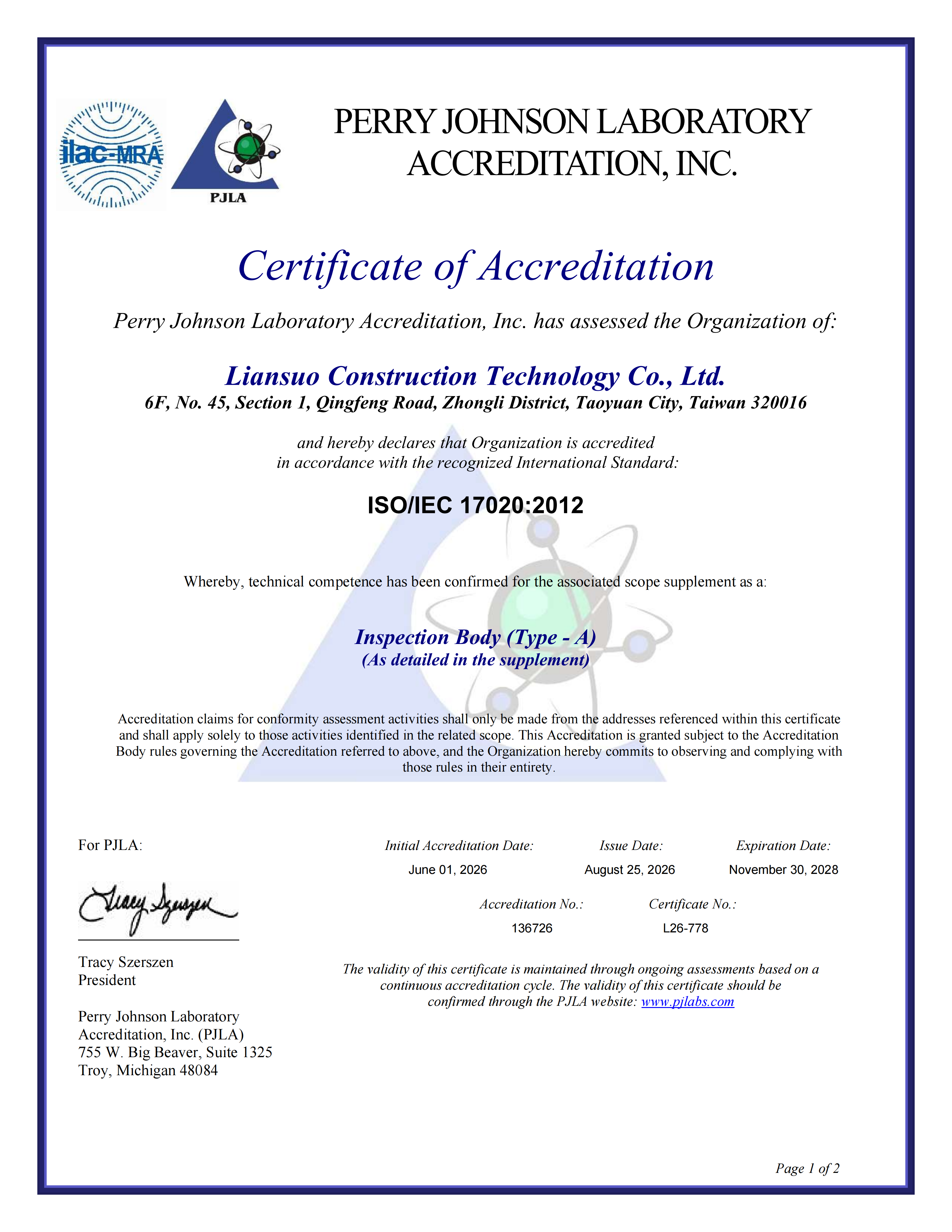
Liansuo Construction Technology Co., Ltd. is accredited by Perry Johnson Laboratory Accreditation, Inc. (PJLA) to ISO/IEC 17020:2012 as a Type A inspection body. On-site inspection services cover only the activities listed in its accredited scope. The ILAC MRA mark relates to this inspection accreditation; it is not a product approval or an individual inspector credential.
Certificate No. L26-778 · Accreditation No. 136726
PJLA Accreditation No. 136726
Initial accreditation: 2026-06-01 · Issued: 2026-08-25 · Certificate expiry: 2028-11-30
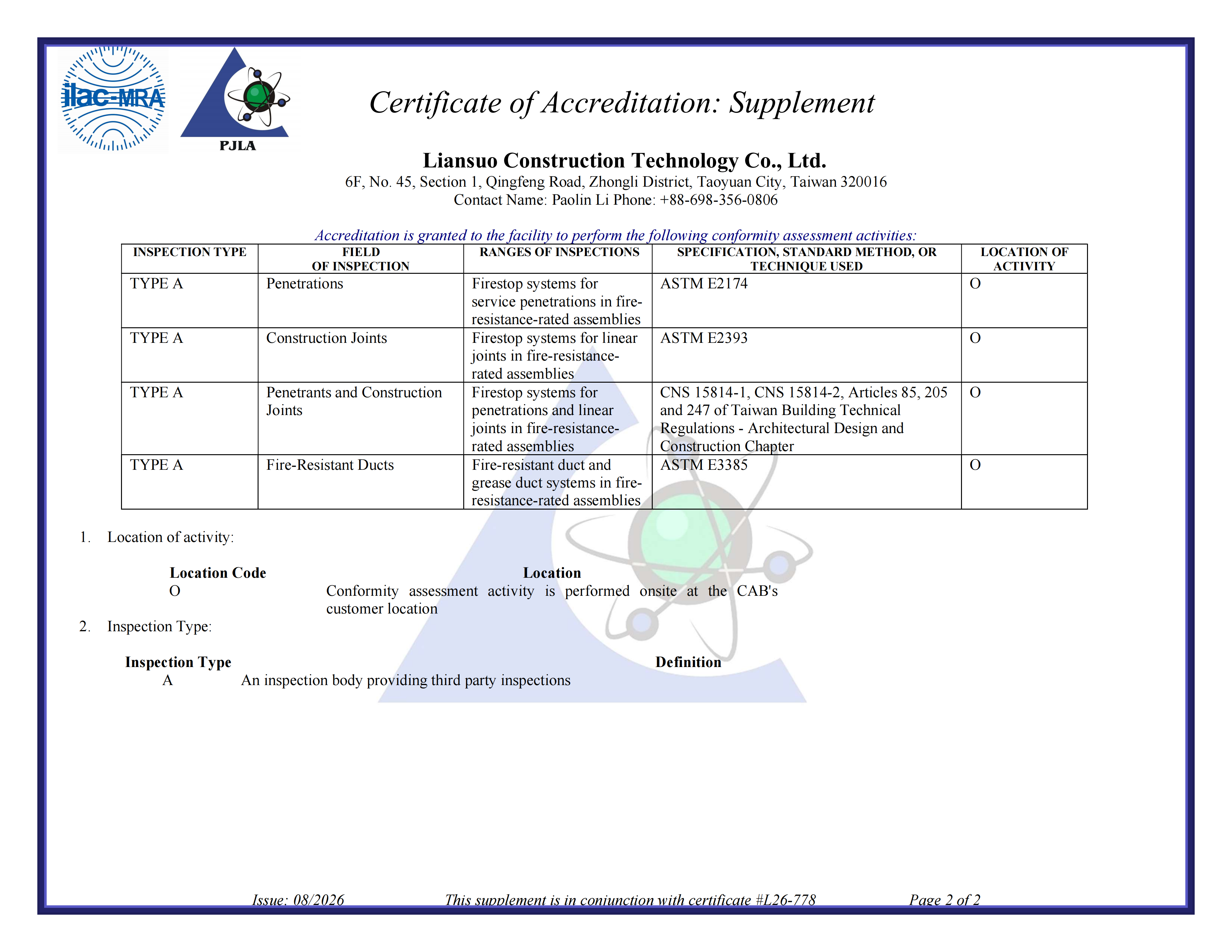
Accredited activity location: on site at the inspection body’s customer location
The dates are taken from the supplied certificate. Confirm current accreditation status with PJLA before relying on it; a future expiry date alone does not establish that accreditation has not been suspended or withdrawn.
Accredited Inspection Scope
- Penetrations — Firestop systems for service penetrations in fire-resistance-rated assemblies (ASTM E2174).
- Construction joints — Firestop systems for linear joints in fire-resistance-rated assemblies (ASTM E2393).
- Penetrations and construction joints — Firestop systems under CNS 15814-1, CNS 15814-2 and Taiwan Building Technical Regulations Articles 85, 205 and 247.
- Fire-resistant ducts — Fire-resistant duct and grease duct systems in fire-resistance-rated assemblies (ASTM E3385).
Firestop Inspection
Independent on-site inspection of installed penetration and linear-joint firestop systems within Liansuo’s accredited scope. Review compares the installed system with the applicable tested or approved system, project documents and inspection requirements. Inspection records observations and findings; it does not guarantee whole-project regulatory compliance or fire performance.
Firestop Inspection Activities
- Penetration Firestops — Inspection of installed firestop systems at service penetrations in fire-resistance-rated walls or floors under ASTM E2174, within the accredited scope.
- Linear-Joint Firestops — Inspection of installed firestop systems at linear construction joints in fire-resistance-rated assemblies under ASTM E2393, within the accredited scope.
Perimeter Fire Barriers — Not separately listed in the supplied accredited scope. Confirm the applicable scope with the inspection body before treating this as an accredited activity.
Firestop Inspection: Review Installed Penetrations and Linear Joints
Firestop systems are intended to maintain fire compartmentation at service penetrations and linear joints. Independent inspection within the accredited scope assesses the installed details against the applicable tested or approved system, compatible materials and documented project requirements; it is not a fire-performance test of the completed building.
Firestop Inspection Checkpoints
- Penetration or joint condition: identify the service or joint, opening, annular space, support arrangement and substrate as applicable.
- System applicability: review whether the tested or approved firestop system matches the actual penetrant or joint, opening, movement and construction.
- Installed details: check material identification, dimensions, backing, depth, fastening and seal continuity against the applicable system, using the approved inspection method.
- Traceable close-out: record inspected locations, evidence, findings, corrective actions and re-inspection status where required.
Five-Step Inspection Process
- Document Review — Review the applicable tested or approved system, project drawings and inspection requirements.
- Material Verification — Check installed material identification and compatibility against the applicable system and project documents.
- Installation Witnessing — Where required by the inspection plan, observe key installation details and record findings against the applicable system requirements.
- Field Inspection — Select the inspection method and sampling plan under the applicable ASTM E2174 or ASTM E2393 requirements and the approved project inspection plan. Record locations, observations and corrective actions.
- Report Preparation — Issue a traceable record of inspection locations, photographic evidence, observations, findings, corrective actions and re-inspection status where required.
There is no single sampling percentage stated here for all projects. The project inspection plan must identify the inspected system, sampling population and unit, method, required frequency, defect handling and re-inspection requirements using the applicable standard edition and project requirements.
Firestop Inspection Records
The agreed inspection record covers inspected locations, photographic evidence, observations and findings, corrective actions and re-inspection status where required. Confirm the report format and close-out requirements in the project inspection plan.
Firestop Inspection FAQ
What is a firestop inspection?
An independent review of installed firestop systems at service penetrations and linear joints within the accredited scope. It compares inspected work with the applicable tested or approved system and documented project requirements. Perimeter fire barriers are not separately listed in the supplied scope and must not automatically be described as accredited activities.
How does firestop installation differ from inspection?
Installation creates the firestop system at an opening or joint. Independent inspection reviews installed details, supporting evidence and corrective-action status under the applicable inspection plan. Inspection is not product certification or a guarantee of the whole building’s fire performance.
Which inspection references apply to firestop systems?
The supplied scope lists ASTM E2174 for penetrations, ASTM E2393 for linear joints, and CNS 15814-1 and CNS 15814-2 with Taiwan Building Technical Regulations Articles 85, 205 and 247. Select the applicable edition, inspection method and sampling plan for the actual system and approved project requirements; no universal percentage is prescribed by this page.
Fire-Resistant Duct Inspection
On-site inspection of fire-resistant duct and grease duct systems in fire-resistance-rated assemblies under ASTM E3385, within Liansuo’s PJLA-accredited scope. Inspection reviews the installed system against the applicable tested assembly and approved project documents. Agreed records include an inspection checklist, photographs, findings and a re-inspection record where required; inspection does not guarantee building-wide compliance or fire performance.
Duct Inspection Activities
- Grease Duct Systems — Inspection of installed fire-resistant grease duct systems against the applicable tested assembly and approved project documents, within the accredited scope.
- Fire-Resistant HVAC Duct Systems — Inspection of installed fire-resistant duct systems in fire-resistance-rated assemblies, within the accredited scope.
Application Boundary — A chemical, laboratory or energy-sector location does not itself establish accredited coverage. The installed fire-resistant duct system and inspection activity must fall within the listed scope; general ventilation and all hazardous exhaust systems are not automatically covered.
Inspection Basis and Supporting Test References
ASTM E3385 is the duct inspection practice listed in the supplied accredited scope. The other references below concern testing or fire containment and may support a project’s tested assembly evidence where applicable; they are not additional accredited inspection methods or product approval claims.
- ASTM E3385 — Standard Practice for On-site Inspection of Fire Resistive Duct Systems; listed accredited inspection activity.
- UL 2221 — Tests of Fire Resistive Grease Duct Enclosure Assemblies; supporting test reference only where applicable.
- ASTM E2336 — Test Methods for Fire Resistive Grease Duct Enclosure Systems; supporting test reference only where applicable.
- ASTM E2816 — Test Methods for Fire Resistive Metallic HVAC Duct Systems; supporting test reference only where applicable.
- ISO 6944-1 — Fire containment for ventilation ducts; supporting reference only where applicable.
Duct Inspection Procedure
- Preparation — Review the applicable tested assembly and project documents, identify materials and components, and agree the inspection plan within the accredited scope.
- Field Inspection — Review duct construction, joints, reinforcement, fire protection, supports and access doors where applicable, against the tested assembly and project inspection requirements. Record inspected locations and findings.
- Reporting and Re-Inspection — Record findings and corrective actions, issue the agreed inspection record, and document re-inspection status where required.
Agreed Duct Inspection Records
- Project Inspection Plan and Work Instruction, as Agreed
- Fire-Resistant Duct Inspection Checklist and Photographic Records
- Inspection Findings and Re-Inspection Record, Where Required
Confirm actual record templates, required photographs, reporting format and corrective-action close-out arrangements before inspection. The listed records are not a product certificate or a whole-project compliance guarantee.
Inspection Scope and Evidence FAQ
Does Type A accreditation certify products or individual inspectors?
No. PJLA ISO/IEC 17020:2012 Type A accreditation applies to Liansuo Construction Technology Co., Ltd. as an independent inspection body and only to its listed activities. It does not certify products or automatically establish a personal credential for each inspector. Check the supplied certificate and scope, and confirm current status with PJLA.
Is one sampling percentage used for every firestop project?
No universal percentage is stated here. The inspection method, sampling population and unit, required frequency, defect handling and re-inspection follow the applicable ASTM E2174 or ASTM E2393 edition and approved project inspection plan for the actual system.
Does duct inspection cover every ventilation or hazardous exhaust system?
No. The supplied scope lists ASTM E3385 inspection of fire-resistant duct and grease duct systems in fire-resistance-rated assemblies. A chemical, laboratory or energy-sector application is considered only if its installed system and inspection activity fall within that scope. Other test references do not extend accreditation.
Discuss an Inspection Requirement
Contact us to discuss your firestop or fire-resistant duct inspection requirements, project documents and inspection plan. Independent, impartial inspections are provided within the applicable accredited scope.
Discuss an Inspection Requirement